Learning Outcomes:
i. After completing this lesson, students will be able to:
ii. Describe the conversion of pyruvate to acetyl-CoA.
iii. Explain the Krebs cycle, also known as the citric acid cycle.
iv. Identify the major steps involved in the Krebs cycle and their products.
v. Recognize the role of the Krebs cycle in energy production.
i. Conversion of Pyruvate to Acetyl-CoA:
After glycolysis, the process of breaking down glucose into pyruvate, pyruvate undergoes further conversion in the mitochondria, the cell's powerhouses. In a process called oxidative decarboxylation, pyruvate loses a carbon dioxide molecule and is converted into acetyl-CoA, a two-carbon molecule. This reaction is catalyzed by the enzyme pyruvate dehydrogenase and releases energy in the form of two high-energy electrons carried by NADH.
ii. The Krebs Cycle:
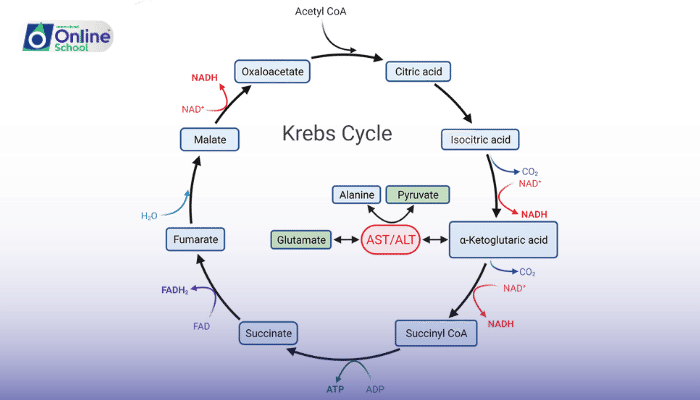
Acetyl-CoA then enters the Krebs cycle, a series of enzymatic reactions that occur in the mitochondria. The cycle is also known as the citric acid cycle due to the presence of citrate, a six-carbon molecule, as an intermediate. During this cycle, acetyl-CoA is combined with oxaloacetate, a four-carbon molecule, to form citrate. Citrate then undergoes a series of transformations, releasing carbon dioxide molecules, high-energy electrons carried by NADH and FADH2, and generating a small amount of ATP.
iii. Steps of the Krebs Cycle:
Citrate Formation: Acetyl-CoA combines with oxaloacetate to form citrate, a six-carbon molecule.
Isocitrate Formation: Citrate undergoes a rearrangement to form isocitrate, another six-carbon molecule.
α-Ketoglutarate Formation: Isocitrate loses a carbon dioxide molecule and is converted into α-ketoglutarate, a five-carbon molecule.
Succinyl-CoA Formation: α-Ketoglutarate combines with coenzyme A (CoA) to form succinyl-CoA, a four-carbon molecule.
Succinate Formation: Succinyl-CoA loses a CoA molecule and is converted into succinate, a four-carbon molecule.
Fumarate Formation: Succinate is oxidized to form fumarate, a four-carbon molecule.
Malate Formation: Fumarate hydrates to form malate, a four-carbon molecule.
Oxaloacetate Regeneration: Malate undergoes an oxidation reaction to regenerate oxaloacetate, a four-carbon molecule, ready to start the cycle again.
iv. Role of the Krebs Cycle:
The Krebs cycle plays a crucial role in energy production. The high-energy electrons carried by NADH and FADH2 generated during the cycle are transferred to the electron transport chain, a series of reactions that ultimately generate ATP, the energy currency of cells. The Krebs cycle also contributes to the synthesis of various organic molecules, such as amino acids and fatty acids.
The conversion of pyruvate to acetyl-CoA and the subsequent entry of acetyl-CoA into the Krebs cycle are essential steps in cellular respiration, the process by which organisms extract energy from organic molecules. The Krebs cycle not only generates high-energy electrons that power the electron transport chain but also contributes to the synthesis of various organic compounds. Understanding the Krebs cycle is fundamental to comprehending the intricate metabolic processes that sustain life.
